Address
Registered office address 4 Dorset Road, London, England, SE9 4QT
Work Hours
Monday to Friday: 7AM - 10PM
Weekend: 9AM - 8PM
Email Us
enquiries@vantixbio.co.uk.
Address
Registered office address 4 Dorset Road, London, England, SE9 4QT
Work Hours
Monday to Friday: 7AM - 10PM
Weekend: 9AM - 8PM
Email Us
enquiries@vantixbio.co.uk.
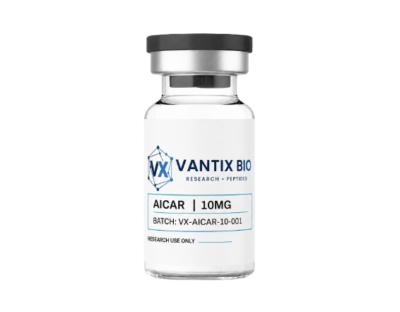
Price range: £64.00 through £90.00
A nucleoside analogue and AMPK activator widely characterised in metabolic research literature. Often co-studied with peptide metabolic compounds.
We’ve brought together the information researchers request most frequently, making it easy to find everything in one place.
Yes. Every batch we supply undergoes independent HPLC analysis by Janoshik Analytical, an accredited Czech laboratory specialising in peptide testing. Reported purity consistently exceeds 99%.
Where available, a printed Certificate of Analysis (COA) is included with your order. If a report has not yet been issued for the current batch, the verification details can be found on our Purity page.
Each COA features a unique verification code that can be checked directly through Janoshik’s verification portal, allowing you to independently confirm the analytical results.
We also provide a guide explaining how to read and interpret Janoshik HPLC reports.
Follow these four simple steps:
1. Clean the vial
Wipe the rubber stopper with one of the supplied alcohol prep wipes and allow it to air dry.
2. Withdraw bacteriostatic water
Using a sterile insulin syringe, draw 2 mL of BAC water through the vial stopper.
3. Add the diluent slowly
Inject the BAC water gently down the inside wall of the peptide vial rather than directly onto the lyophilised powder.
4. Dissolve the contents
Swirl the vial carefully until the powder has dissolved completely. Avoid shaking. Allow approximately 30 seconds before refrigerating.
A reconstitution reference card is included inside the box lid for future use.
Clean the pen tip with an alcohol wipe before securely attaching a new sterile needle.
Turn the dose dial one click, hold the pen upright and press the dose button. A small droplet at the needle tip confirms successful priming and removal of air.
Each click delivers a fixed increment based on the pen calibration, typically between 0.5 mg and 1 mg per click. The viewing window displays the selected amount.
For example, a 6 mg research setting may correspond to approximately 6–12 clicks depending on calibration.
Published research protocols commonly describe subcutaneous administration using sites such as the abdomen, thigh or upper arm. Administration sites are generally rotated during research procedures.
Dispose of the needle safely in a sharps container, replace the pen cap and return the pen to refrigerated storage.
Each pen provides the number of administrations shown in the protocol guide for the selected format. When empty, simply replace the refill cartridge while continuing to use the same pen body.
Research use only. The information above reflects published research protocols and is not intended as medical advice or guidance for human use.
Once opened, refrigerate and use within 30 days.
Published literature involving AICAR commonly describes subcutaneous administration in areas including the abdomen, thigh and upper arm within pharmacokinetic and clinical research settings. Researchers generally rotate administration sites throughout study protocols to minimise repeated local tissue stress.
This information is provided solely for scientific context and is drawn from peer-reviewed literature. It should not be interpreted as dosing instructions or medical guidance.
Reference: Narkar et al. (2008)
The recommended approach is to follow the published research protocol applicable to your study.
Research involving AICAR commonly follows a gradual titration schedule, beginning with lower levels before increasing according to predefined study intervals. Many published research protocols identify a maintenance phase where ongoing investigation continues.
Researchers beginning work with this compound typically start with the initial protocol phase before progressing according to the study design.
Those already familiar with the protocol can review the appropriate phase to determine expected product usage, duration and associated costs.
If your research follows a custom protocol, our team can help identify the most suitable vial or pen size before you order.
Research use only. Information is summarised from peer-reviewed scientific literature and is provided for research context only. It is not medical advice or guidance for human use.
Reference: Narkar et al. (2008)
| Category | Details |
|---|---|
| Compound | AICAR |
| Research Category | Metabolic Research |
| Available Sizes | 50 mg, 100 mg |
| Pricing | From £64 |
| Format | Lyophilised powder in a sealed vial |
| Purity | >99% by independent HPLC testing (Janoshik Analytical) |
| Intended Use | In-vitro laboratory research only. Not for human consumption. |
The information below is compiled from publicly available scientific databases and peer-reviewed publications for laboratory reference purposes.
| Property | Information |
|---|---|
| Compound Class | Small-molecule AMPK activator (5-aminoimidazole-4-carboxamide ribonucleotide) |
| Molecular Formula | C₉H₁₄N₄O₅ |
| Molecular Weight | 258.23 g/mol |
| CAS Registry Number | 2627-69-2 |
| PubChem CID | 17513 |
| Mechanism | AMP analogue and AMPK pathway activator |
| Reported Half-life | Short serum half-life reported in published literature |
| Solubility | Suitable for laboratory reconstitution using bacteriostatic water |
| Storage (Lyophilised) | Stable at 2–8°C for 24+ months |
| Storage (Reconstituted) | Store refrigerated at 2–8°C; use within 14 days |
| Research Status | Investigational compound for laboratory research |
AICAR (Acadesine; 5-aminoimidazole-4-carboxamide ribonucleotide) is a synthetic AMP analogue widely described in scientific literature as an activator of AMP-activated protein kinase (AMPK) in experimental models. It is supplied as a lyophilised powder for laboratory and in-vitro research applications only.
Descriptions above summarise published scientific literature and are not intended as claims regarding effects in humans.
AICAR is supplied as a freeze-dried powder in a sealed glass vial.
For laboratory preparation, slowly introduce the required volume of bacteriostatic water or another suitable laboratory diluent down the inside wall of the vial. Gently swirl until fully dissolved, avoiding vigorous shaking or vortex mixing.
Prepared solutions should be refrigerated at 2–8°C and protected from light.
Use the Reconstitution Volume Calculator to calculate the final concentration (mg/mL).
| State | Storage Temperature | Typical Shelf Life |
|---|---|---|
| Lyophilised | 2–8°C or -20°C | Up to 24 months |
| Reconstituted | 2–8°C | Approximately 4–6 weeks |
Every batch of AICAR undergoes independent HPLC analysis by Janoshik Analytical before being supplied.
Where a current Certificate of Analysis is available, it accompanies the order and includes a verification code that can be authenticated directly through Janoshik’s official records.
Reported purity consistently exceeds 99%.
Researchers investigating AICAR frequently also study:
| Size | 50mg, 100mg |
|---|---|
| Format | Pen, Vial |

Reviews
There are no reviews yet.