Address
Registered office address 4 Dorset Road, London, England, SE9 4QT
Work Hours
Monday to Friday: 7AM - 10PM
Weekend: 9AM - 8PM
Email Us
enquiries@vantixbio.co.uk.
Address
Registered office address 4 Dorset Road, London, England, SE9 4QT
Work Hours
Monday to Friday: 7AM - 10PM
Weekend: 9AM - 8PM
Email Us
enquiries@vantixbio.co.uk.
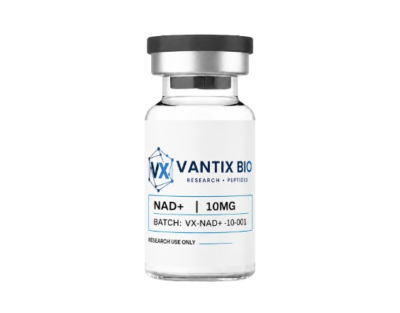
Price range: £64.00 through £114.00
A pyridine dinucleotide cofactor essential to redox metabolism, energy production and sirtuin / PARP signalling. Reference standard for mitochondrial and ageing research.
Everything researchers commonly contact us about, organised clearly in one place.
Yes. Every batch is independently verified through Janoshik Analytical HPLC testing.
Each product supplied undergoes analysis by Janoshik Analytical, a Czech laboratory specialising in peptide and compound testing that operates independently from us. Reported purity levels consistently exceed 99%.
When a Janoshik Certificate of Analysis (COA) has been issued for the current batch, a printed copy is included with the order. If a report is not available, the corresponding verification record is published on our Purity page.
Every COA includes a unique verification key that can be checked through Janoshik’s own verification platform, allowing researchers to independently confirm the analytical results.
We also provide information on how to interpret Janoshik HPLC reports for full transparency.
Follow these four simple preparation steps:
Use an alcohol prep wipe from the supplied kit to disinfect the vial tops. Allow them to dry fully before use.
Using an insulin syringe, withdraw 2 mL of BAC water through the rubber stopper of the vial.
Inject the liquid slowly down the inside wall of the vial. Avoid directing the stream directly onto the lyophilised powder.
Carefully swirl the vial until the contents are fully dissolved. Do not shake. Allow approximately 30 seconds for complete dissolution before refrigeration.
Use the reconstitution card inside the box lid as a quick reference for future preparation.
Clean the pen tip using an alcohol wipe, then securely attach a new foil-wrapped needle.
Turn the dial one click, hold the pen upright and press the dose button. A small droplet at the needle tip confirms successful priming and removal of air.
Each click delivers a fixed increment according to the pen calibration. Typical resolution is 0.5–1 mg per click, with the dose window displaying the selected amount.
Example: a 6 mg research setting may require approximately 6–12 clicks depending on calibration.
Published research protocols describe subcutaneous administration routes, including areas such as the abdomen, thigh and upper arm. Researchers commonly rotate locations throughout study procedures.
Dispose of the needle safely in a sharps container. Replace the pen cap and return the pen to refrigerated storage.
Each pen provides the number of uses specified for the selected format. When the cartridge is empty, replace it while continuing to use the same pen body.
Research use only. The information provided is based on published research protocols and does not constitute medical advice or guidance for human use.
After opening, refrigerate and use within approximately 30 days.
Published research literature involving NAD+ describes subcutaneous administration routes in pharmacokinetic and clinical research settings, including areas such as the abdomen, thigh and upper arm.
Researchers commonly rotate administration locations during studies to minimise repeated local tissue stress.
This information is provided solely for scientific context from peer-reviewed literature. It should not be interpreted as dosing instructions, medical guidance or recommendations for human use.
Reference: Yoshino et al. 2018
The recommended approach is to follow the relevant published research protocol.
Research involving NAD+ commonly uses staged progression, beginning with lower research levels and increasing according to predefined study schedules. The highlighted phase within the protocol materials represents the stage where many research groups continue ongoing investigation.
Researchers new to this compound typically review the initial phase before progressing through later stages according to their study design.
Researchers with previous experience can review the available phase information to determine expected product requirements, duration and format.
For customised research schedules, contact our team before ordering. We can help identify the most suitable option based on your planned research requirements.
Research use only. Information is derived from peer-reviewed literature and provided for scientific context only. It is not medical or human-use guidance.
Reference: Yoshino et al. 2018
| Category | Details |
|---|---|
| Compound | NAD+ |
| Research Category | Longevity Research |
| Available Sizes | 100 mg, 500 mg, 1000 mg |
| Pricing | From £64 |
| Format | Lyophilised powder in sealed vial and pre-reconstituted pen |
| Purity | >99% HPLC verified by Janoshik Analytical |
| Intended Use | In-vitro laboratory research only. Not for human consumption |
Information below is compiled from public scientific databases, including PubChem and UniProt, alongside peer-reviewed literature. It is intended for laboratory reference and characterisation purposes only.
| Property | Information |
|---|---|
| Compound Class | Nicotinamide adenine dinucleotide (cellular coenzyme) |
| Molecular Formula | C21H27N7O14P2 |
| Molecular Weight | 663.43 g/mol |
| CAS Registry Number | 53-84-9 |
| PubChem CID | 925 |
| Mechanism | Coenzyme involved in redox reactions; substrate for sirtuins, PARPs and NAD+ kinases |
| Reported Half-life | Short serum half-life reported; intracellular NAD+ dynamics widely studied |
| Solubility | Suitable for laboratory reconstitution using bacteriostatic water |
| Storage (Lyophilised) | 2–8°C; stable for 18+ months; light sensitive |
| Storage (Reconstituted) | 2–8°C; protect from light |
| Research Status | Endogenous metabolite widely studied in research |
NAD+ (Nicotinamide Adenine Dinucleotide) is a naturally occurring cellular coenzyme described in scientific literature for its involvement in redox reactions, sirtuin activity and mitochondrial-related pathways in experimental models.
It is supplied as a lyophilised powder intended exclusively for in-vitro laboratory research.
The information above summarises scientific characterisation from published literature and does not represent claims regarding effects in humans.
NAD+ is supplied as a freeze-dried powder in a sealed glass vial.
For laboratory preparation, add the required volume of diluent slowly along the inside wall of the vial. Gently swirl until fully dissolved. Avoid shaking or vortex mixing.
Prepared solutions should be stored at 2–8°C and protected from light.
Use the Reconstitution Volume Calculator to determine the resulting concentration in mg/mL.
| State | Temperature | Typical Shelf Life |
|---|---|---|
| Lyophilised | 2–8°C or -20°C | Up to 24 months |
| Reconstituted | 2–8°C | Approximately 4–6 weeks |
Every batch of NAD+ supplied undergoes independent HPLC verification by Janoshik Analytical.
Where a Janoshik report is available for the current batch, it is supplied with the order and includes a unique verification key that can be authenticated against Janoshik’s records.
Reported purity consistently exceeds 99%.
Researchers studying NAD+ commonly investigate related longevity-focused compounds, including:
Compare NAD+ with related compounds for differences in mechanism, pricing and laboratory handling considerations.
| Size | 500mg, 1000mg |
|---|---|
| Format | Pen, Vial |

Reviews
There are no reviews yet.